
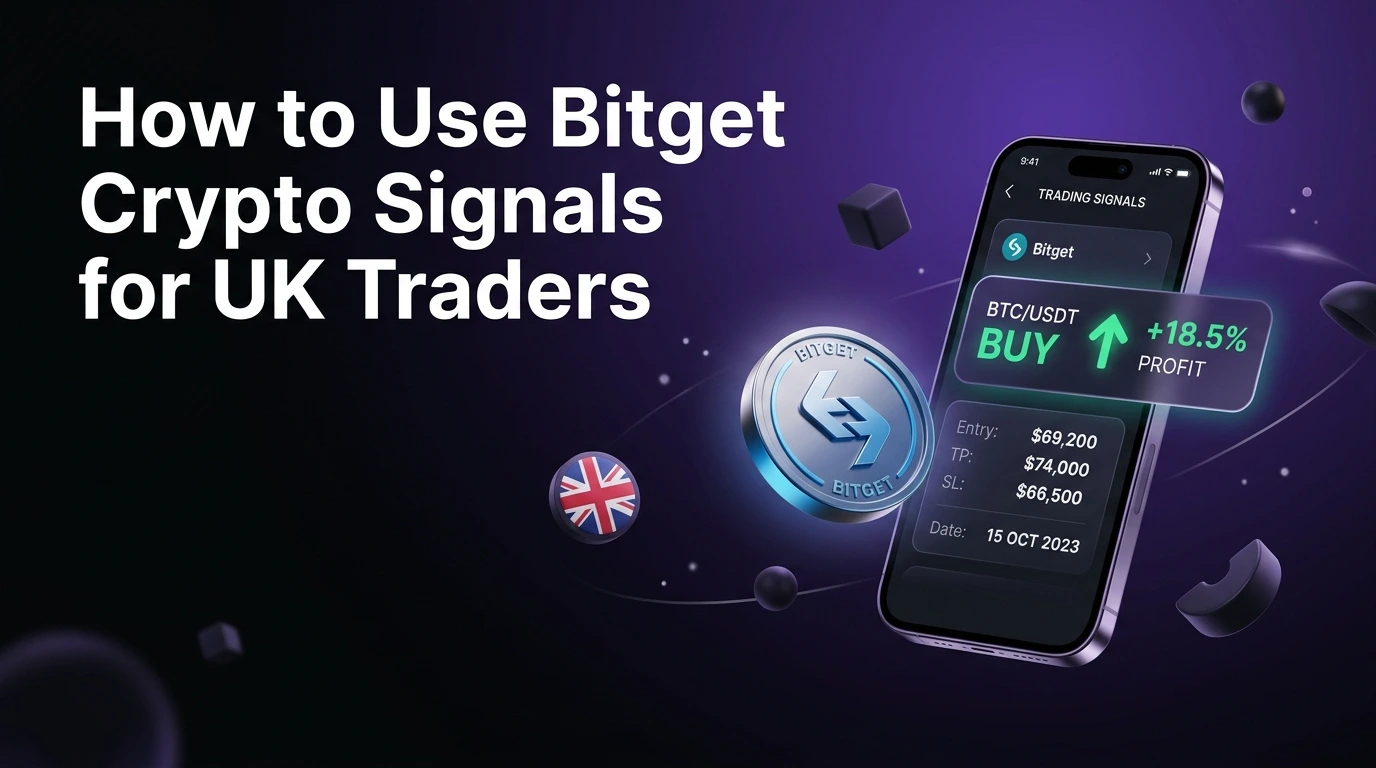
Crypto signals are trade recommendations delivered through Telegram, Discord, or dedicated apps. Each signal typically includes a coin pair (e.g., BTC/USDT), a direction (long or short), an entry zone, one or more take-profit targets, and a stop-loss level. When these signals are formatted specifically for execution on Bitget, they account for the exchange's available pairs, fee tiers, and margin modes.
Unlike generic alerts that leave you guessing which platform to use, Bitget-specific signals match the exact trading pairs and order types available on the exchange. That means you spend less time adapting recommendations and more time executing them.
Signal providers focused on Bitget often cover both USDT-M futures and spot markets. Some also include Bitget's coin-margined contracts, giving UK traders flexibility across multiple account types without switching platforms.
Why UK Traders Are Choosing Bitget in 2026
Bitget has rapidly climbed the exchange rankings. According to CoinGecko's exchange tracker, Bitget consistently sits inside the top five derivatives platforms by 24-hour volume. For UK-based traders, several features stand out.
Low Trading Fees
Bitget charges 0.02% maker and 0.06% taker fees on futures — among the lowest in the industry. For spot trading, the standard rate is 0.1% per side, with further discounts for BGB token holders. Lower fees mean more of each signal's profit stays in your account.
Copy Trading Integration
Copy trading on Bitget lets you mirror the positions of top-performing traders automatically. Some signal providers double as elite traders on the platform, so you can follow their signals manually or copy their live portfolio in one click. This dual approach suits beginners who want a safety net and experienced traders who want speed.
GBP On-Ramp Options
Bitget supports GBP deposits through third-party providers, making it straightforward for UK traders to fund accounts without currency conversion delays. Faster funding means you can act on time-sensitive signals before the entry window closes.
Regulatory Awareness
While Bitget is not FCA-regulated for derivatives, the exchange holds licences in multiple jurisdictions and has invested heavily in proof-of-reserves transparency. UK traders should always assess their own regulatory comfort level before trading on any offshore platform.
How Bitget Crypto Signals Work — Step by Step
Setting up a signal workflow on Bitget takes less than ten minutes. Here is the process broken down into clear stages.
Step 1: Choose a Verified Signal Provider
Start by finding a trusted Telegram crypto signal channel that explicitly supports Bitget. Look for providers who publish verified track records with timestamps, not just cherry-picked screenshots. A minimum of 90 days of auditable history is a solid benchmark.
Red flags include guaranteed returns, pressure to deposit large amounts, and channels that delete losing signals. Transparency is non-negotiable.
Step 2: Fund Your Bitget Account
Deposit funds into your Bitget wallet using crypto transfer or a GBP fiat gateway. For futures trading, transfer the balance from your funding wallet to your futures wallet inside the Bitget app. Keep your initial allocation modest — £100 to £500 is a sensible starting range while you evaluate signal quality.
Step 3: Understand the Signal Format
A typical Bitget signal looks like this:
| Component | Example | Meaning |
|---|---|---|
| Pair | SOL/USDT | The trading pair on Bitget |
| Direction | Long | Buy expecting price to rise |
| Entry Zone | $168.50 – $171.00 | Price range to open the trade |
| Take Profit 1 | $178.00 | First target — close partial position |
| Take Profit 2 | $185.00 | Second target — close remaining |
| Stop Loss | $163.00 | Exit price if the trade goes wrong |
| Leverage | 5x–10x | Suggested margin multiplier |
Every component matters. Skipping the stop-loss or ignoring the entry zone turns a calculated trade into a gamble. Signals that include stop-loss levels protect your capital during sudden market reversals.
Step 4: Execute the Trade on Bitget
Open the Bitget app or web terminal. Navigate to the correct pair (e.g., SOL/USDT Perpetual). Select your margin mode — isolated margin is recommended for signal-based trades because it limits risk to the allocated margin for that specific position.
Set a limit order at the signal's entry price. Input your take-profit and stop-loss levels using Bitget's TP/SL order feature. Confirm the trade. The entire process takes under two minutes once you are familiar with the interface.
Step 5: Monitor and Manage
After the trade is live, monitor the signal channel for updates. Good providers send real-time adjustments — trailing the stop-loss higher as price moves in your favour or cancelling a signal if market conditions change before entry is filled.
Avoid the temptation to override signal parameters. If the provider says close at TP2, close at TP2. Discipline is what separates profitable signal followers from those who blow accounts.
Bitget Signals for Spot vs. Futures Trading
Not all signals are created equal. The type you follow should match your risk tolerance and experience level.
| Feature | Spot Signals | Futures Signals |
|---|---|---|
| Risk Level | Lower — you own the asset | Higher — amplified by margin |
| Profit Potential | Moderate (1x exposure) | High (up to 125x on Bitget) |
| Liquidation Risk | None | Yes — if margin is insufficient |
| Best For | Beginners, long-term holds | Experienced short-term traders |
| Holding Period | Days to weeks | Minutes to days |
| Fees on Bitget | 0.1% maker/taker | 0.02% maker / 0.06% taker |
If you are new to signals, start with spot trading signals for beginners. Spot trades eliminate liquidation risk entirely, letting you learn the workflow without the pressure of margin calls.
Automating Bitget Signals with Bots
Manual execution works, but automation removes human delay. Several tools connect Telegram signal channels to Bitget's API, placing trades the moment a signal drops.
Cornix Bot
Cornix is the most popular Telegram trading bot for signal automation. It reads formatted signals from your subscribed channels and executes them on Bitget automatically. You configure risk settings — position size, maximum number of open trades, and trailing stop preferences — once, and the bot handles the rest.
Bitget's Built-In Copy Trading
If your signal provider also trades on Bitget, you can skip external bots entirely. Bitget's native copy trading feature lets you mirror their positions with customisable allocation limits. You set a fixed amount per trade or a percentage of your portfolio, and the system copies every open and close in real time.
API-Based Custom Bots
Advanced traders can build custom bots using Bitget's REST and WebSocket APIs. Python libraries like pybitget simplify order placement, position management, and balance queries. This approach suits traders who want full control over execution logic, risk filters, and position sizing algorithms.
Risk Management Rules for Signal Trading on Bitget
Signals are tools, not guarantees. Even the best provider has losing trades. Protecting your capital requires strict discipline.
The 1–2% Rule
Never risk more than 1–2% of your total trading account on a single signal. If your Bitget futures balance is £1,000, your maximum loss per trade should be £10 to £20. This rule ensures no single bad signal can cause meaningful damage to your portfolio.
Always Use the Stop-Loss
Every credible signal includes a stop-loss. Use it. Moving or removing stop-losses because you "feel" the trade will recover is the fastest way to empty an account. Bitget allows you to set stop-loss orders at the time of entry — there is no excuse to skip this step.
Avoid Over-Leveraging
Bitget offers up to 125x on certain pairs. That does not mean you should use it. Most professional signal providers recommend 3x to 10x for futures trades. Higher multiples amplify losses just as aggressively as they amplify gains.
Diversify Signal Sources
Following a single provider creates concentration risk. Consider subscribing to two or three crypto trading signal channels with complementary strategies — one focused on Bitcoin, another on altcoins, and a third on swing trades. Diversification smooths your equity curve over time.
How to Evaluate a Bitget Signal Provider
The signal space is crowded, and not every channel delivers value. Use this checklist before subscribing.
- Verified track record: At least 90 days of timestamped results with win rate, average R:R, and total PnL.
- Transparent losing trades: Providers who hide losses are providers you cannot trust.
- Bitget-compatible pairs: Signals should specify pairs available on Bitget. Generic "BTC long" signals without pair details waste your time.
- Active community: A Telegram group with real discussion — not just bot-generated hype — indicates genuine engagement.
- Risk management included: Every signal must include a stop-loss. Providers who skip this are gambling with your money.
- No guaranteed returns: Any provider promising fixed daily or monthly profits is either deceptive or delusional. Markets do not work that way.
- Free trial or free channel: Reputable providers let you test their signals before paying. A free tier shows confidence in their product.
Common Mistakes UK Traders Make with Bitget Signals
Knowing what to avoid is just as valuable as knowing what to do. These are the most frequent errors.
Entering Late
Signals have an entry zone for a reason. If the price has already moved 3–5% past the recommended entry, the risk-to-reward ratio has shifted against you. Skip the trade and wait for the next one.
Ignoring Funding Rates
Bitget perpetual futures charge or pay funding rates every eight hours. If you hold a long position during a period of high positive funding, you pay a fee that eats into profits. Check the current funding rate before opening any position that you plan to hold overnight.
Trading Every Signal
Not every signal suits your strategy. If you trade only Bitcoin but the provider sends an obscure altcoin signal, it is perfectly fine to pass. Selectivity is a skill.
Neglecting Tax Obligations
UK traders must report Capital Gains Tax (CGT) on crypto profits above the annual allowance. Bitget provides trade history exports that simplify this process. Use a dedicated crypto tax tool like Koinly or CoinTracker to stay compliant with HMRC requirements.
Best Practices for Combining Signals with Your Own Analysis
Blindly following signals is better than blindly trading alone — but combining signals with your own research produces the best results.
Before acting on any signal, spend 60 seconds checking:
- Market context: Is Bitcoin trending up, down, or sideways? Altcoin signals perform best when BTC is stable or rising.
- Volume confirmation: Is the pair showing above-average volume on Bitget? Low volume increases slippage risk.
- News events: Is there a major economic release (CPI, FOMC) or crypto-specific event (token unlock, hard fork) within the trade's expected duration?
- Technical alignment: Does the signal's entry coincide with a support level, moving average, or other confluence zone on your own charts?
This 60-second filter does not override the signal — it helps you size your position with more confidence. Strong confluence means a larger allocation. Weak confluence means a smaller one or a skip. Learning to read crypto trading charts makes this process significantly more effective.
Bitget-Specific Features That Enhance Signal Trading
Bitget offers several tools that signal followers can use to improve execution quality.
Strategy Orders
Bitget's strategy order system lets you set conditional entries. If a signal says "enter if BTC breaks $72,000," you can place a stop-limit order that only activates at that price. This is especially useful for breakout-style signals when you cannot watch the screen.
Grid Trading Bot
For range-bound signals, Bitget's built-in grid bot automates buy-low-sell-high cycles within a defined price range. This pairs well with sideways-market signals that identify support and resistance levels rather than directional trades.
Demo Trading
Bitget provides a demo trading account with virtual funds. New signal followers should test a provider's alerts in demo mode for at least two weeks before risking real capital. This validates both the signal quality and your execution speed without financial exposure.
Frequently Asked Questions
Is Bitget safe for UK traders?
Bitget is not FCA-regulated for derivatives, but it maintains proof-of-reserves and holds licences in other jurisdictions. UK traders can use the platform, but they should understand the regulatory limitations and never trade with funds they cannot afford to lose. Over 20 million users globally trust the platform as of early 2026.
How much money do I need to start using Bitget crypto signals?
You can start with as little as £50 for spot trading or £100 for futures. However, a balance of £200 to £500 gives you enough room to follow multiple signals simultaneously while keeping individual position risk at 1–2% of your account.
Are free Bitget signal channels reliable?
Some free channels deliver genuinely useful signals as a gateway to their premium service. Others are low-quality or outright scams. Verify any free provider by checking at least 30 days of results before trading with real money. Channels tied to established communities with verifiable PnL tend to be the most trustworthy.
Can I automate Bitget signals without coding?
Yes. Cornix bot connects your Telegram signal channel to Bitget via API and executes trades automatically. Setup takes under ten minutes and requires no programming knowledge. Bitget's own copy trading feature is another no-code option.
What is the best leverage to use with Bitget signals?
Most reputable signal providers recommend 3x to 10x for futures trades. Higher values increase both profit potential and liquidation risk. Beginners should start at 3x to 5x and increase only after building confidence and a positive track record over several weeks.
Final Thoughts
Bitget crypto signals offer UK traders a structured, data-backed approach to navigating volatile markets. The combination of Bitget's low fees, advanced order types, and copy trading infrastructure makes it one of the most signal-friendly exchanges available. But no signal removes the need for personal responsibility — proper risk management, stop-loss discipline, and ongoing education remain the pillars of consistent performance.
Start small, validate every provider before committing real capital, and treat signals as one input within a broader trading system. The traders who thrive are not those who follow blindly — they are the ones who combine external intelligence with their own growing expertise.
⚠️ Disclaimer: Trading cryptocurrencies involves significant risk. This content is educational and not financial advice. Past performance does not guarantee future results.
Explore Our Crypto Signal Pages