
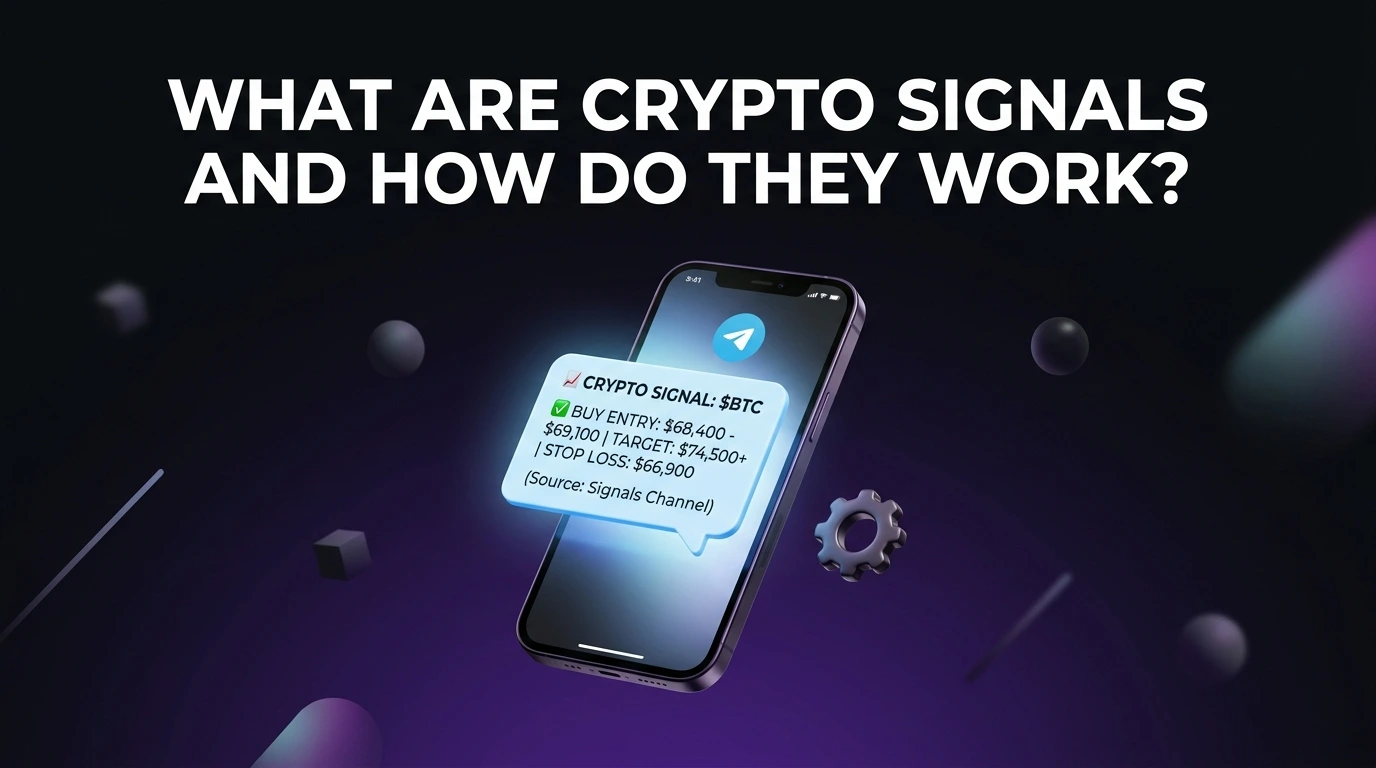
A crypto signal is a trade idea published by an experienced analyst, a professional trading team, or an automated system. Each signal contains all the information you need to execute a specific trade on a cryptocurrency exchange — Binance, Bybit, Bitget, or OKX being the most common platforms used by UK traders.
Think of it this way: instead of spending hours studying candlestick charts, reading market news, and calculating risk-to-reward ratios yourself, a signal provider does that work and delivers the conclusion directly to your phone. Your job is to evaluate whether the signal fits your risk tolerance, then execute it on your exchange if it does.
Signals are not predictions or guarantees. They are informed trade ideas backed by analysis. The best signal providers maintain a 65–80% win rate across hundreds of trades — meaning even the top professionals are wrong 20–35% of the time. The difference between profitable and unprofitable trading is not being right on every signal; it is managing risk so that your winners outweigh your losers over time.
How Are Crypto Signals Delivered?
The overwhelming majority of crypto signals in 2026 are delivered through Telegram. The platform dominates signal distribution for several practical reasons.
First, Telegram supports channels — broadcast-style groups where only the provider can post. This eliminates noise from member chat and ensures every message in the channel is a signal, update, or result. Second, Telegram's push notifications are instantaneous, which is critical when a signal has a narrow entry window. Third, the platform supports rich message formatting, pinned messages, and media — allowing providers to share charts alongside their trade setups.
Some providers also use Discord, email, or proprietary apps, but Telegram remains the industry standard. If you are exploring signal channels for the first time, our step-by-step guide to crypto signals on Telegram walks through the entire process from joining a channel to executing your first trade.
What Does a Crypto Signal Actually Look Like?
A properly formatted crypto signal contains several critical components. Below is a realistic example of what you would receive on a Telegram signal channel, followed by a detailed breakdown of each element.
📊 SIGNAL — BTC/USDT LONG
Exchange: Binance (USDT-M Futures)
Entry: $97,200 – $98,000
Stop-Loss: $94,500
TP1: $101,000 (+3.2%)
TP2: $105,500 (+7.9%)
TP3: $110,000 (+12.5%)
Leverage: 5x–10x
Risk: Medium | Timeframe: 3–7 days
Each line in that message serves a specific purpose. Here is what every component means.
Trading Pair
The trading pair identifies which asset you are trading and what it is priced against. BTC/USDT means Bitcoin priced in Tether (USDT). Nearly all crypto signals use USDT-denominated pairs because stablecoins eliminate the variable of your quote currency fluctuating during the trade. You will occasionally see pairs quoted against BUSD or USDC, but USDT is the standard.
Direction: Long or Short
A long signal means the analyst expects the price to rise — you buy at the entry price and sell higher for a profit. A short signal means the analyst expects a price decline — you sell first and buy back at a lower price. Shorting is a more advanced technique that involves margin trading, so beginners should focus exclusively on long signals and spot trades initially.
Entry Zone
The entry zone is the price range where you should open your position. It is always a range (e.g., $97,200 – $98,000) rather than a single exact number, because crypto prices move continuously. This window gives you time to enter without needing to hit a precise figure.
If the price has already moved well beyond the entry zone by the time you see the signal, do not chase it. A missed entry is always better than an overpaid one. Discipline around entry prices separates successful signal followers from those who consistently overpay and then watch their risk-to-reward ratios collapse.
Stop-Loss
The stop-loss is the most important element of any signal. It is the price at which your position closes automatically to cap your losses. In the example above, a stop-loss at $94,500 means your trade exits if Bitcoin drops to that level, limiting your downside to a defined, manageable amount.
Never remove or widen a stop-loss. This single rule will protect your account more than any indicator, strategy, or provider ever could. For a detailed look at how stop-losses function within signal-based trading, read our article on crypto signals with stop-loss protection.
Take-Profit Targets (TP1, TP2, TP3)
Take-profit targets are the price levels where you close portions of your position to secure gains. Most signals include two or three graduated targets. A standard scaling approach is to close 40% of your position at TP1, 30% at TP2, and the final 30% at TP3.
This tiered method ensures you lock in some profit even if the price reverses before reaching all targets. If TP1 hits and the trade then turns against you, you have already banked a portion of your gains instead of watching the entire position evaporate.
Leverage and Risk Rating
Leverage (margin) multiplies both your exposure and your risk. At 5x leverage, your £200 position controls £1,000 worth of cryptocurrency. Higher leverage amplifies both gains and losses — a 5% move against you at 20x leverage liquidates your entire position. Beginners should trade spot (no leverage) or use a maximum of 3x–5x until they understand position sizing thoroughly.
The risk rating (Low, Medium, High) provides the analyst's confidence assessment. As a beginner, prioritise Low and Medium risk signals until you have built experience and a consistent execution process.
How Crypto Signals Are Generated
Understanding how signals are produced helps you assess their reliability. There are three primary methods, and the best providers in 2026 typically combine two or more of them.
Technical Analysis (TA)
Technical analysis involves studying price charts, candlestick patterns, and mathematical indicators to forecast future price movements. Analysts examine support and resistance zones, moving averages (MA, EMA), RSI, MACD, Bollinger Bands, volume profiles, and Fibonacci retracement levels to identify high-probability trade setups.
According to Investopedia, technical analysis is the most widely used method for generating short-to-medium-term trading signals across all financial markets, including crypto. TA-based signals perform best in clearly trending markets where historical patterns tend to repeat. In choppy, range-bound conditions, they produce more false signals — a quality provider recognises this and reduces signal frequency accordingly.
Fundamental Analysis (FA)
Fundamental analysis evaluates a cryptocurrency's underlying value: the development team, technology stack, real-world adoption metrics, tokenomics, partnerships, and competitive positioning. FA-driven signals tend to be longer-term and focus on projects that are undervalued relative to their catalysts.
For beginners, FA signals are often easier to understand intuitively. "This project just partnered with a major payment processor and has an upgrade launching next month" is more accessible than "Bullish hidden divergence on the 4H RSI with MACD histogram flipping positive." The trade-off is that FA-driven price movements can take weeks or months to materialise.
Algorithmic and AI-Based Signals
Algorithmic signals are generated by trading bots or machine learning models that process massive volumes of data — price action, volume, order book depth, social media sentiment, on-chain transaction flows, and whale wallet movements — far faster than any human can. These systems identify statistical patterns and produce trade recommendations based on backtested probability models.
The strength of algorithmic signals is speed and objectivity. They process data without emotional bias and can scan hundreds of trading pairs simultaneously. The weakness is adaptability: algorithms struggle with unprecedented events — regulatory announcements, exchange hacks, or macroeconomic shocks — that fall outside their training data. The most effective providers combine algorithmic screening with human verification before publishing any signal.
Types of Crypto Signals You Will Encounter
Not all signals are created equal. Different types serve different trading styles, timeframes, and risk tolerances. Here is a comparison to help you identify which type matches your situation.
| Signal Type | Best For | Risk Level | Typical Hold Time |
|---|---|---|---|
| Spot Signals | Beginners, conservative traders | Low–Medium | Days to weeks |
| Futures Signals (Long) | Intermediate traders | Medium–High | Hours to days |
| Futures Signals (Short) | Experienced traders | High | Hours to days |
| Scalping Signals | Full-time active traders | High | Minutes to hours |
| Swing Trade Signals | Part-time traders with day jobs | Medium | Days to weeks |
| Altcoin Gem Signals | High-risk, high-reward seekers | Very High | Varies widely |
Spot signals are the safest starting point for anyone new to crypto trading. You purchase the actual cryptocurrency with your own funds — no borrowing, no margin, no liquidation risk. Your maximum loss is capped at your initial investment, and you can hold through temporary drawdowns without the threat of forced liquidation. Once you are consistently profitable with spot signals for 2–3 months, consider exploring futures signals with conservative leverage.
How Crypto Signals Work in Practice: The Full Workflow
Understanding the theory is one thing. Knowing how signals function in a real trading workflow is what actually makes them useful. Here is the end-to-end process from receiving a signal to closing the trade.
1. Signal Arrives on Telegram
Your phone buzzes with a notification from the signal channel. The message contains the full trade setup: pair, direction, entry zone, stop-loss, take-profit targets, leverage recommendation, and risk level. You read the signal within seconds of it being posted — timing matters because entry zones have windows.
2. You Evaluate the Signal
Before acting, ask three questions. Is the price still within the entry zone? Does the risk level match your current tolerance? Do you have enough capital to position size correctly with the 1–2% rule? If all three answers are yes, proceed. If any answer is no, skip this signal and wait for the next one.
3. You Execute on Your Exchange
Open your exchange (Binance, Bybit, etc.), navigate to the trading pair, and place your order at the entry zone price. Set your stop-loss immediately — before doing anything else. Then set your take-profit orders at the specified levels. Many exchanges allow you to set all of these simultaneously using OCO (One Cancels the Other) or conditional order features.
4. The Trade Plays Out
Once your orders are set, the trade runs on autopilot. If the price hits your stop-loss, the position closes and you take a small, predefined loss. If the price hits TP1, your first portion closes at a profit. If it continues to TP2 and TP3, you bank larger returns. You do not need to watch the chart constantly — the orders handle everything.
5. You Record the Result
After the trade closes, record the outcome in a spreadsheet or trading journal: pair, entry, exit, profit or loss, and any notes. This habit lets you track the signal provider's actual performance over time and identify patterns in your own execution.
How to Evaluate a Crypto Signal Provider
Not every signal channel delivers value. These five metrics separate legitimate providers from noise and scams.
| Metric | What Good Looks Like | Red Flag |
|---|---|---|
| Win Rate | 60–80% across 50+ verified trades | Claims of 95%+ with no auditable proof |
| Risk-to-Reward Ratio | Average of 1:2 or better | Signals without stop-losses |
| Track Record | 3+ months of publicly visible results | Only showing last week's winners |
| Transparency | Losses published openly alongside wins | Deleted messages where signals hit SL |
| Signal Volume | 3–8 quality signals per day | 20+ low-quality alerts flooding the channel |
A channel that meets all five criteria has demonstrated consistent, verifiable performance. For community-reviewed options, see our article on the best crypto signal channels for beginners in 2026.
Free vs Paid Crypto Signal Channels
Both free and paid signal channels can be legitimate, and both can be scams. Understanding each model helps you set the right expectations.
Free Channels
Free signal channels act as a showcase for the provider's analytical ability. They typically publish 2–4 signals per day with full formatting (entry, SL, TP) and earn revenue through exchange referral links, advertising, or by converting free followers to a paid tier. A quality free channel posts all results transparently — including losing trades. If a free channel only displays wins and deletes messages that hit stop-loss, leave immediately.
Paid Channels
Paid channels charge a subscription fee — usually £30–£150 per month — and provide higher signal frequency (5–10 daily), priority alerts, in-depth market analysis, educational content, and sometimes direct access to the analyst for questions. The added volume and educational materials can accelerate a beginner's learning curve considerably.
Before paying, always test the provider's free tier or paper trade their signals for at least two weeks. Never pay a large upfront fee to any channel that cannot show a verifiable, publicly auditable track record. For a broader comparison of what is available for free, see our article on free crypto signals for spot trading.
Common Mistakes to Avoid When Using Crypto Signals
Even the best signals fail when the person executing them makes avoidable errors. Here are the five most common mistakes and how to sidestep each one.
Chasing Entries Beyond the Zone
If the entry zone says $97,200–$98,000 and the price is already at $102,000, the risk-to-reward equation has fundamentally changed. Your stop-loss is now proportionally further away, and your take-profit targets offer less upside. Skip it. There will always be another signal.
Removing or Widening the Stop-Loss
This is the single fastest path to account destruction. Every stop-loss exists for a calculated reason. Removing it because you "feel" the price will recover is not analysis — it is hope. Hope does not manage risk.
Oversizing Positions
Putting 20–50% of your account into one signal transforms trading into gambling. Even top-tier providers experience losing streaks. The 1–2% risk rule ensures your account survives those streaks and remains viable for the winning trades that follow.
Following Too Many Channels
Joining five or ten signal groups simultaneously creates information overload and conflicting recommendations. Start with one well-vetted channel. Master the full workflow — receive, evaluate, execute, manage, record — from a single source before expanding.
Revenge Trading After a Loss
Revenge trading means immediately entering a larger position to "win back" what you lost. It is the second most common account killer after removing stop-losses. After a losing trade, close the app. Review the result objectively later. The market will be there tomorrow.
Crypto Signals vs Trading Bots: A Quick Comparison
Many beginners confuse signals with trading bots. While related, they serve different purposes.
Crypto signals give you a trade idea that you execute manually. You maintain full control over whether to follow the recommendation, how much capital to allocate, and when to exit. Signals are educational — every trade you execute teaches you something about market behaviour.
Trading bots automate the execution entirely. You connect a bot to your exchange via API, and it opens and closes positions based on predefined algorithms without your manual input. Bots offer convenience but remove the learning component and require trust in the algorithm's logic.
For a detailed breakdown of how these two approaches compare in terms of performance, cost, and risk, see our article on crypto signals vs trading bots.
Frequently Asked Questions
What are crypto signals in simple terms?
Crypto signals are trade recommendations that tell you which cryptocurrency to buy or sell, the exact price to enter at, where to place your stop-loss to limit risk, and at what price levels to take profit. They are delivered via Telegram (most commonly), and each signal functions as a complete trade plan you can execute on your preferred exchange.
How much does it cost to follow crypto signals?
Many providers offer free channels with 2–4 daily signals. Paid tiers typically range from £30 to £150 per month and include more signals, deeper analysis, and priority alerts. Always paper trade or test the free tier before subscribing. The quality of a signal provider is determined by their track record, not their price.
Are crypto signals accurate?
Accuracy varies by provider. A realistic and sustainable win rate for a quality signal channel is 65–80% across at least 50 tracked trades. Any channel claiming 95%+ accuracy without publicly auditable proof should be treated with extreme scepticism. Consistent profitability comes from managing risk properly, not from achieving a perfect win rate.
Can beginners use crypto signals successfully?
Yes. Signals were originally designed to help less experienced traders access professional-level analysis. The key is to start with spot signals (no leverage), paper trade for 2–4 weeks before using real money, apply the 1–2% risk rule on every trade, and never remove your stop-loss. These four habits make signals a practical tool for beginners from day one.
Are crypto signals legal in the UK?
Yes. Sharing crypto trade ideas is legal in the UK, provided the provider does not claim to offer regulated financial advice without FCA authorisation. Most signal channels operate as educational or informational services and include clear disclaimers. As a trader, you are fully responsible for your own decisions and any applicable tax reporting to HMRC.
Final Thoughts
Crypto signals are structured trade instructions that remove guesswork and replace it with a plan — entry, stop-loss, take-profit, and risk level — for every position you take. They are generated through technical analysis, fundamental research, algorithmic models, or a blend of all three, and delivered primarily via Telegram to UK traders in 2026.
Understanding how signals work is foundational. Each component exists for a reason: the entry zone controls your cost basis, the stop-loss protects your capital, and the take-profit targets define your reward. Together, they form a complete strategy for each trade. Start with one signal channel, trade spot only, paper trade before risking real money, and apply the 1–2% rule without exception. Master these basics, and every advanced technique you encounter later will build on a solid, proven foundation.
⚠️ Disclaimer: Trading cryptocurrencies involves significant risk. This content is educational and not financial advice. Past performance does not guarantee future results.
Explore Our Crypto Signal Pages